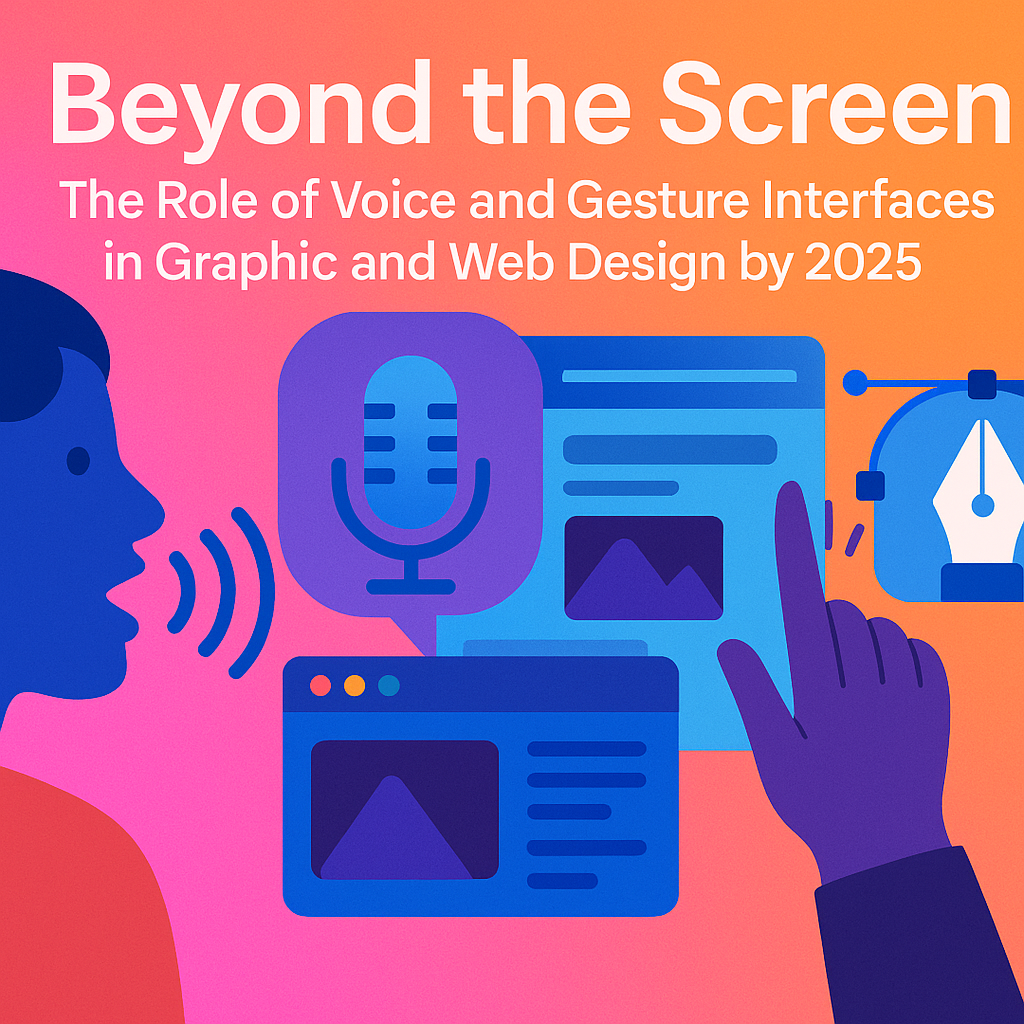
Beyond the Screen: The Role of Voice and Gesture Interfaces in Graphic and Web Design by 2025
As we rapidly approach 2025, the avenues of user interaction with digital technology are expanding beyond the traditionally dominant touchscreen interfaces. Graphic and web design professionals are preparing for a paradigm shift ignited by the integration of voice and gesture interfaces, which promise to transform how users engage with digital content.
The rise of smart speakers and voice assistants like Amazon Alexa, Google Assistant, and Apple’s Siri has already begun steering users towards voice-enabled technology in their everyday lives. By 2025, voice interfaces are expected to evolve drastically, offering a seamless, hands-free navigation experience across digital platforms. Such advancements will necessitate designers to craft UX frameworks that accommodate natural language processing and voice command functionalities, enabling users to interact with websites and applications verbally with ease and efficiency.
Gesture interfaces, on the other hand, are poised to turn our very movements into inputs. Thanks to advancements in sensors and motion-detection technologies, interactive design will extend far beyond mouse clicks and screen taps. Web and graphic designers will have the opportunity to leverage this mode of input to create more immersive experiences by assessing user environments and applying gestural inputs to trigger actions. Imagine browsing a website with just a flick of your wrist or pinching the air to zoom in on a product – these are the interactions of the near future.
This evolution is not just a technical challenge but also a creative juncture for designers. The shift calls for a new set of guidelines, best practices, and tools that articulate the language of voice and gesture into design elements. As technology narrows the gap between human actions and machine responses, designers must deepen their understanding of human-centric design principles, ensuring intuitive and accessible user experiences for diverse audiences.
Moreover, privacy, security, and accessibility will loom large in the discourse surrounding these interfaces. As voice and gesture-based interactions collect sensitive user data, designers and developers must prioritize safeguarding user privacy and adhering to regulations.
Looking beyond 2025, the integration of voice and gesture interfaces is set to encourage an inclusive future in web and graphic design, where intuitive interactions become the norm. By embracing these cutting-edge technologies, designers have the opportunity to reimagine digital interactions, taking creativity and functionality to unprecedented heights. As we step into this future, the horizon for designers is not just what’s on the screen but what lies beyond it.